

**Collaborative post**
Looking after children with any type of disability can be particularly challenging and any parent of a child with even a mild disability, be that physical or mental, will know that it can be challenging and often frustrating, just getting on with your normal day-to-day life.
From sleeping, dressing, eating, travelling… and many other activities in or out of the home, it’s often the case that children with a disability need both adaptations in the home, but also specialist equipment and aids to help them live an independent and enjoyable life.
The field of product development for children’s and young adult’s disability aids falls under the category of paediatric equipment.
Paediatric equipment can cover a very wide range of equipment, from wheelchairs and powerchairs, beds and chairs – right through to the simplest of daily living aids, such as feeding spoons and pencil grippers.
It’s true to say, that in the last decade, the advances in the range and quality of disability aids for children have increased substantially, as manufacturers have woken up to the fact that disabled children make up a very large section of the general community.
Product research has led to the greater use of technology, with lightweight materials, brighter colours and improved aesthetics tailored to children’s fashion tastes. As well as more compact and innovative designs and solutions.
An example of this is the Paediatric Walking Frame, this lightweight yet very strong piece of equipment can help with balance, posture and mobility and comes in a bright and friendly colour, appealing to children’s tastes.
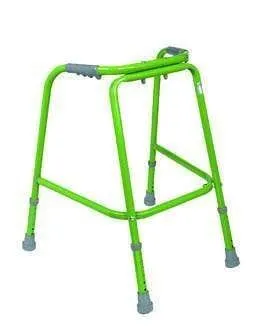
This walking frame allows for a maximum weight of 100Kgs (16 st) meaning it’s good for any size of child right up to young adults and for bariatric requirements.
The feet are fully adjustable and the tips of the feet are made from a non-marking rubber, suitable for all surfaces.
At the younger end of the spectrum, sometimes it can be difficult to feed babies and progress their eating and drinking habits. The Doidy Cup has been designed to encourage babies to drink from a rim rather than a spout.

Babies as young as 6 months find the two-handled cup easy to hold and to drink from as the natural action used is the same as in breastfeeding.
The Doidy Cup also helps prevent tooth decay and speech problems associated with weaning from the bottle.

Still, on the subject of eating and drinking, the Paediatric Suction Bowl is another great innovation in product development that can really help children to eat independently.
The bowl is unbreakable and comes in a fun, child-friendly design they’ll love to use. A non-slip suction ring keeps the bowl in place at mealtimes, another great idea that can make mealtimes fun and safe for children.
For writing and drawing, holding pens and pencils, as well as coordinating pens to allow for focused writing can be difficult for your disabled child, or for any child in general that struggles to grip a pen or pencil.
A great invention that can really help, is the pack of three pen and pencil grippers.
These grippers, simply fit onto the shaft of the pen or pencil and allow for an easier grip, so holding the pen with control becomes much easier for the child, allowing for reduced frustration and more focused writing drawing and other pen or pencil based activities.
I hope you’ve enjoyed reading about a few of the many products that can allow your child, with any form of disability, live a more enjoyable life, whilst making your life as a parent or carer easier and less stressful.
To see a much greater range than this small sample, please take a look at our Paediatric Equipment category page where you’ll find a much more detailed selection.
Phil Ashforth is a staff writer for Mobility Smart, an online retailer of health, wellbeing and mobility equipment to help you recover from injury and recuperation, or just helping solve your mobility issues in normal daily life, you’ll find their website here

Related Posts:






Discover more from Emmy's Mummy
Subscribe to get the latest posts sent to your email.
