
**Collaborative post**
Bicarb soda (or baking soda) is most commonly used as a leavening agent in baking, but it’s also a super versatile, non-toxic cleaning product. It can be used as a stain remover, a deodoriser and even for polishing surfaces. Better still, it’s inexpensive and available in large quantities, ideal for the committed bulk buyers among you!
Read on to learn how to use bicarb soda to transform your kitchen cleaning routine.
Unblock your kitchen sink
There are plenty of commercial products available that are designed to unblock sinks but many contain harmful chemicals such as sodium hydroxide, and there are safer alternatives that can be just as effective.
If your sink isn’t badly clogged you may get away with simply boiling the kettle and pouring hot water down the plughole, freeing up any food waste that may be stuck.
If this isn’t effective, pour half a cup (around 65g) of bicarb down the plughole, then follow this with two cups (250g) of spirit vinegar. The alkaline bicarb soda will react with the acidic vinegar, resulting in a sort of explosion of froth that should dissolve any nasties stuck in either the plughole or the trap.
Deodorise your appliances
One of the most useful properties of bicarb soda is how it can literally suck up unpleasant odours where many other products instead just try to mask the foul smells.
If you’ve removed the rotten or otherwise smelly items from your refrigerator but are struggling to tackle the odour that’s been left behind, place a small dish of bicarb on a shelf in your fridge and leave it for a few days.
The same principle also works for other appliances – for example, if you’re unable to rid your microwave of that burnt popcorn smell, place two tablespoons of bicarb in a cup of water and heat for three minutes on the highest setting. Repeat if necessary, remembering to wipe down the microwave’s surfaces when you’re done.
Dishwashers can also begin to smell bad after a while, but it’s nothing that a cup or 125g of bicarb soda can’t handle. Sprinkle the powder around the bottom of the dishwasher and run empty on the hottest setting.
Funky smelling washing machine? Remove and clean the detergent drawer and thoroughly wipe down any seals or gaskets where old detergent may have accumulated. Place two cups or 250g of bicarb directly into the drum and run the machine on a long, hot cycle.
Polish surfaces
Bicarb soda when mixed into a paste has effective cleaning properties and is ever so slightly abrasive, which is ideal for polishing a variety of different surfaces, from countertops to stainless steel and even silver.
Make the paste by mixing a half cup or around 65g of bicarb with a few tablespoons of water, adding water slowly until you find the correct consistency.
Before you get started, it’s recommended that you test the paste on a small, preferably hidden-away area to make sure it’s not going to damage the surface. Dip a soft, lint-free cloth into the paste and apply it to the surface, rubbing lightly. Once you’re confident that it won’t do any damage, you can apply the mixture to the entire area. When finished with the bicarb soda you can dampen a different cloth with olive oil, buffing the surface until any water spots or streaks are removed. This method is really useful for cleaning stainless steel sinks, but do bear in mind that stainless steel surfaces that have a striated finish will require you to rub in the direction of the grain for best results.
Remove burnt or baked-on residue from pans
We’ve all done it – left a pan on the hob just a little too long, or perhaps quite a bit too long! It’d be tempting to look at what’s left of your balsamic reduction and decide to chuck the pan straight in the bin, but there’s a better way.
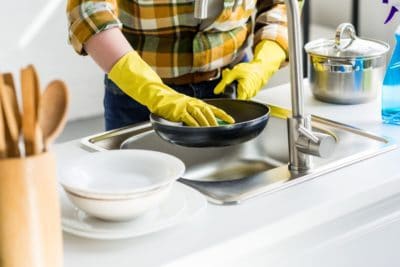
Sprinkle a generous amount of bicarb into the pan along with a squirt of washing up liquid, before adding boiling hot water from the kettle. Let this sit for around half an hour so that the bicarb soda can help dissolve the baked-on remains of your dinner. Once you’ve waited a while, empty the pan and tackle with a sponge or scourer as normal.
Really stubborn build-up may benefit from the weapon of last resort – a dishwasher tablet dropped in the pan with hot water, placed on the hob to simmer for around 20 minutes. If that doesn’t work then you’ll be needing a new pan.
Remove stains from plastic containers
If you’ve ever stored curry or a ragù sauce in Tupperware you’ll know that your nice new plastic container will never be the same again. The turmeric in the curry and tomato in the ragù will stain the plastic, making it look and often smell rather unpleasant even after being thoroughly cleaned.
Prepare the same paste we mixed for surface polishing – half a cup or 65g of bicarb mixed with a few tablespoons of water. Rub this paste into the plastic surface of the container and then leave it to sit for around 24 hours, before rinsing the paste away. It may be necessary to repeat the process to remove very stubborn stains, but bicarb is genius at removing discolouration that even the most potent commercial cleaning products can’t touch.
Hopefully, these tips will turn you on to the cleaning power of a simple, natural cooking ingredient that we all have in our kitchen cupboard. If you have any clever uses for bicarb soda – whether in the kitchen or elsewhere in the home – please do share in the comments.
Author bio
Ellie Rush is Outreach Executive at The Cleaning Collective and is a Friends superfan, sharing her passion for household cleanliness with Monica Geller. She loves to offer housekeeping hints and tips to her Cleaning Collective friends and is always looking for new ways to clean that do the least harm to the environment.

Related Posts:


Discover more from Emmy's Mummy
Subscribe to get the latest posts sent to your email.
