

**Collaborative post**
Ever wondered why your bedroom doesn’t look cohesive?
It seems like you have tried all the décor tips & tricks, followed all the rules, and did your research in all the magazines.
Even so, the result still doesn’t look like that Pinterest picture.
What is it that you are missing? What are you doing wrong, and why is your bedroom not as you have envisioned?
Here are 7 of the most common decorating mistakes that can completely mess up your décor.
Not Hanging Your Curtains High Enough
The way you hang your curtains can make or break your bedroom design.
Most people tend to hang the curtains at the wrong height, and it’s never a good look to plonk your curtains right on the window frame.
Curtains hanging at the right size will enhance the feeling of space, making your room appear taller and brighter.
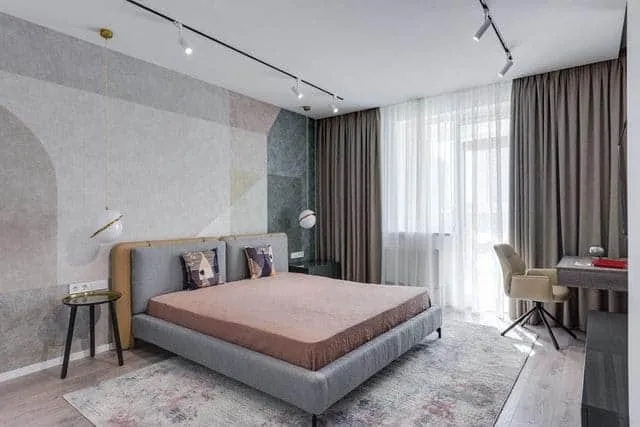
Hanging curtains just below the ceiling and allowing them to extend down to the floor will also make your windows appear more significant, and you can benefit from more natural light.
Besides the way you hang your curtains, you should also pay close attention to your curtain’s length, width, and fullness.
Curtains look best when they come to the floor, they should completely cover the window frame, and they need ruffles and waves to give them fullness.
Choosing the Wrong Size of Rug
Rugs can anchor your space, and they can create division.
And your bedroom is no exception when it comes to styling your home with new rugs.
In combination with a stylish bed, a good rug will provide a soft cushion underfoot, and it will help create a central focus for your room.

The layout of your bedroom will influence the rug size and shape.
If you are lucky enough to have a large master bedroom, choose a rug size large enough to fit both your bed and your nightstands when it’s placed perpendicular to them.
If you have a smaller bedroom and you only want to add a bit of extra comfort, then tuck a six by 9-foot rug under your bed just up to the nightstands to provide soft cushioning as you step out of bed in the morning.
Ideally, in a bedroom, the majority of your bed should sit above the rug. However, you should allow a minimum of 50-60cm of the uncovered rug at the end of the bed to see its benefits.
For example, for a standard double bed, the rug size would be 200*300.
Bed Size Rug Size
Twin 5′ * 8′
Full 6′ * 9′
Queen 8′ * 10′
King 9′ * 12′
Room Size Rug Size
5 * 7 feet 3 * 5 feet
7 * 10 feet 5 * 8 feet
10 * 12 feet 8 * 10 feet
11 * 14 feet 9 * 12 feet
14 * 17 feet 12 * 15 feet
Hanging Your Art Too High or Too Low
Art that is hanging too high or too low on a wall is a common mistake.
A good rule of thumb is to hang art so that its midpoint is between 57 and 60 inches from the floor.
In rooms with ceilings higher than 8 feet, artwork can be hung a little higher than 60 inches off the floor.
The best height is when your eye is at the center of the painting.
If you are hanging art above furniture, for example, above your bed, make sure the artwork is central above or balanced with other items.
If you are creating a gallery wall, a minimum of 10 cm is recommended between frames.

Not Measuring Before You Purchase
There is nothing worse than falling in love with a bed and then purchasing it, to realise that it is too big or too small for your sleeping needs.
It is tempting to select a gorgeous king-size bed, we know, but it’s not nice to realise that you have no walking space around it after.
If your bedroom is on the smaller side, a large bed can make it feel cramped and uncomfortable.
You can find out the minimum space needed around your bed by calculating your bedroom’s dimensions using the basic formula: length * width = area.
Once you have your bedroom dimensions, you can then consider the bed size.

A bed should have two feet of walking space around it to have room to make the bed without knocking into walls.
It’s also important to factor in space for the bedroom décor pieces, closets, and drawers to open without obstacles.
Placing All Furniture Against The Walls
Betsy Burnham of Burnham Designs states that people often fall into this trap: “For some reason, people love to push their furniture pieces up to the walls of their rooms. Which makes designers crazy, and it doesn’t save or create more space.”
The solution is to pull pieces toward one another and off the walls to create more intimate, helpful seating.
Play with the placement of your furniture.
According to your bedroom size, the room will feel more extensive and more spacious if you create more walkways by centering your furniture or making a couple of zones with furniture and rugs.
Not Planning Enough Storage
Even the best-designed spaces will look less appealing when filled with clutter.
So make sure you plan enough storage for your space.
When it comes to the bedroom, a bed with storage such as a divan bed with drawers or an ottoman bed will help you keep out of sight the things you rarely use.

Try to incorporate furniture that doubles up as storage and helpful organization ideas into your design.
Poor Lighting
Having just one light source is yet another common interior design mistake.
The best-designed spaces have numerous light sources to create variate moods, and the bedroom is no exception.
Every bedroom should have a mix of lighting, including overhead, accent lighting, and task lighting, and a combination of both portable and installed lighting for tasks like dressing and reading.
Generally, you’ll want your lights spaced three to five feet apart in an average-sized room.
Four to eight lights are usually enough for bedroom use, and keep in mind – dimmer switches are your best friend.

Think of a mixture of recessed fixtures, sconces, ceiling lights, table lamps, pendants, floor lamps, and portable reading lights.
And there you have it. You now know seven of the most common bedroom mistakes and a bunch of advice on how to avoid these decorating flaws.

Related Posts:



Discover more from Emmy's Mummy
Subscribe to get the latest posts sent to your email.
