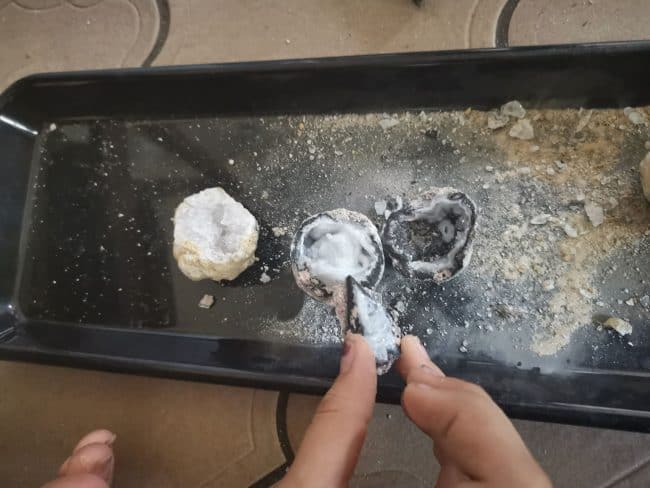
The National Geographic range of STEM learning kits for children are really great fun and Emmy is certainly exploring all the new ones which have been arriving since we were chosen as Bandai STEM Ambassadors a few months back. You can take a look at what we thought of the National Geographic STEM Dig Kits here. For our next review, Emmy was sent one of the National Geographic GEODES STEM learning kits to crack open 2 Geodes to discover.
Here we are taking a closer look at the National Geographic GEODES STEM learning kits
Inside the box you will find:
2 GEODES
Safety goggles
Magnifying glass
Information booklet
Instructions
A stand for your geodes to be displayed
You will also need
Hammer
Chisel
Sock – optional
What are Geodes?
Geodes are spherical to subspherical rock structures with an internal cavity lined with mineral materials. They have a durable outer wall that is more resistant to weathering than the surrounding bedrock. This allows the geode to survive intact when the surrounding bedrock weathers away. The mineral lining the cavity is often a scintillating druse of tiny quartz crystals underlain by multiple bands of translucent grey and white agate.
These sphere-shaped rocks get their name from the Greek words for “shape of the Earth”. They look like ordinary rocks but hold a beauty inside which will only be discovered once they are cracked open.
Cracking open our Geodes
There are 2 ways in which you can crack open these Geodes, the first is for younger children – you place your rock inside a sock and hit it with a hammer. By placing into the sock it helps to contain the mess which is made and means there is no chance of flying pieces of the rock hitting you in the face or getting in your eyes.
This way of opening is less precise and you can’t guarantee it will break in half and you could end up breaking if rather unevenly, but that is OK and you will still see the beauty which is hidden inside.
The other way of opening involves using a hammer and a chisel which is what Emmy did. You use the hammer to hit the chisel, moving around the rock in a circular motion – so a few hits before repositioning the chisel to circle all the way around its circumference.
It is rather hard to crack open and does take a lot of effort to break into. You really DO have to ensure you are wearing the safety goggles as pieces of rock to fly up and it begins to crack open.
Emmy found getting these open really difficult and after trying for quite some time she happily handed over the hammer to her Dad who took great pleasure in hitting it open.
Types of Geodes
Pyrite Geodes
Nicknamed fool’s gold, pyrite is a shiny, yellow-coloured material that is often mistaken for real gold. The best pyrite geodes feature incredible spray crystal formations. Because the beautiful radiating sprays of pyrite look like sunbeams, these formations are called sun crystals.
Fluorescent Geodes
Some geodes will glow or “fluresce” under ultraviolet light. This is especially true of geodes with crystals made of fluorite and calcite.
Agate
Agate is a variety of quartz made up of tiny microcrystals. It typically has a very fine grain and bright colours, often featuring stripes of different hues.
Amethyst
Amethyst is a member of the quartz family. It can range in colour from light pink to deep purple, sometimes with red or blue secondary hues. Amethyst geodes are among the most highly prized specimens.
Calcite
This is a common constituent of limestone, a sedimentary rock, and therefore a common mineral found in geodes. Calcite crystals have three sides and range in colour from clear to shades of red and orange.
Quartz
Quartz is the second most abundant mineral in the Earth’s continental crust, and it is the most common mineral found inside geodes. Quartz crystals have six sides and can vary in colour depending upon the purity of the minerals. The purest quartz, often called rock crystal, is colourless and transparent.
Drusy Quartz
Quartz featuring tiny, sparkling crystals is often called drusy quartz. During the geodes’s formation, rapid cooling causes these tiny, shimmering crystals to form over other minerals.
Scepter Quartz
Quartz crystals are called scapter quartz when the clusters form into long, narrow points that resemble a king’s scepter.
Which did we discover?
After cracking open our geodes I handed over the information booklet to Emmy so she could read and discover which she had uncovered.
Using the process of elimination, looking closely through the microscope at her rocks and reading the guide very careful, Emmy has decided that she has found a Calcite and a Quartz.
This kit is available to buy on Amazon and from many other good retailers and is priced at £9.99
Subscribe to get the latest posts sent to your email.
Clare
Hi, I'm Clare (Emmy's Mummy). A former Nanny and Mother of 2 - Emmy (born February 2010) and Harry (born October 2012). We are Essex based and share our adventures and misadventures of a busy crazy life.