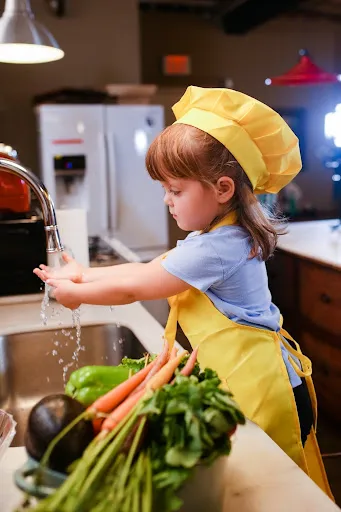
When you have kids, all you want to do is wrap them up in cotton wool, and for the first few years of their lives, they are totally dependent on you to care for them, so it is only natural that a lot of parents find it difficult to actually loosen the apron strings and give their kids more independence as they get older and are more able to take care of themselves.
Of course, it’s really important that you do let your children do stuff for themselves because, as a parent, teaching your kids how to be independent is vital if you want them to be safe, happy and successful now, and when they ultimately fly the nest.
Okay, but how exactly do you teach your kids independence? Here are some of the best places to start.
Young children, in particular, will find it easier to gain more independence if they have a strong routine in place. When they know what they should be doing at any given time, it’s easier for their young brains, which do not always think sequentially, to take some control of their lives and do more for themselves without prompting.
Give them age-appropriate responsibilities
One of the best ways to teach children how to be more independent is to give them choices that are age-appropriate, and which you think they should be able to handle with relevant ease. This could be something as simple as making them responsible for clearing away their toys or maybe choosing a healthy menu for the week, depending on their age. Basically, if the task is simple enough and nothing will majorly go wrong if they don’t get it right, letting your children have responsibility for various aspects of their own life as soon as possible will help them to be more confident about running their own lives when the time comes that you cannot be there and do it all for them.
Give them more choice
From a young age, it can be a really good idea to present your children with two or more choices whenever there is a possibility to do so. Why do this? Because choices give independence and because giving your children a choice not only empowers them but makes them think more about who they are and what their likes and dislikes may be. It helps them to work out who they are independent of their parents and this is always a good thing that will help your children to grow and develop in as healthy a way as possible.
Don’t constantly hand-hold your child
Depending on how old your child is, they may need more or less supervision, but even if they do need to be supervised, you should not necessarily make it obvious to them that is what you are doing, and you should certainly not keep intervening in every little thing your child is doing unless they are posing a serious risk to themselves or someone else. It is natural to want to hover over your child when they are doing something new for the first time, or to bark instructions at them when they’re doing something in a way that you might not, but this kind of hand-holding will only hamper them from learning new skills and fostering their own independence. So, by all means, help when it is really needed, but otherwise, back off, let them explore and they will most likely come to you when they really need help anyway.
Let them make their own decisions
You are the parent, so naturally, you will think that you know best for your children, and maybe you do, but when it comes to teaching them independence, you need to let them make their own choices, at least some of the time. For example, you may think that it’s a good idea for your child to do their homework as soon as they get home so that it’s out of the way, but she may prefer to do it after playing with her friends for a while – as long as it gets done, does it really matter? You can always talk through the pros and cons of each, and you may have to impose your will if it all goes wrong, but if you don’t even let her try doing things her way, how is she possibly going to learn to manage her life independent of you?
Let them explore
Obviously, you shouldn’t be letting a toddler head off to the local park unsupervised or packing your young teen off to a foreign country without adult supervision, but there are so many parents who won’t even let their children play in the safety of their own garden without them, nor will they let older children go out with friends without breathing down their necks and this makes it really difficult for them to gain any independence.
These days, we have security cameras, and phones with affordable mobile contracts, which means we can keep tabs on our kids in the garden or if they head to town with friends, with relative ease, which means there is no reason not to let them have a bit more freedom and explore once you feel like they are sensible enough to do so. Oh, and while you let them explore, don’t breathe down their necks – heck in with them by all means, but let them have some fun too!
Be empathetic
Showing your children some empathy is really important when you are teaching them independence because many children will struggle with greater levels of freedom and they won’t always get things right or make the best decisions. That is all part of growing up. Sometimes, we need to fail in order to learn a valuable lesson about ourselves and the world around us, but if you judge your children for their mistakes, they will stop even trying and you will have an anxious child on your hands.
Don’t get mad at failures
As mentioned above, some children will fail when they are given more independence. They may forget to call you to check in or neglect their homework in favour of being with their friends, and although this is not ideal behaviour, and you can and should talk to them about it, do so calmly. Explain why ut’s important to do X, Y, Z, but that you also understand that no one is perfect and we all make mistakes from time to time. Comfort them if they are upset about what has happened and help them to come up with strategies so that things don’t go wrong next time. This will help them to learn independence much more effectively and it will help you to maintain a strong and open relationship with them.
Let them solve their own problems
It can be tempting to dive in and try to solve your child’s problems for them, but this will only ever help them in the short term; if you want them to be independent in the long term. Let them navigate that fall out with their friend or allow them to find out for themselves that eating too much chocolate before bedtime is a recipe for an upset stomach all while making it clear you will be there for them if they do need help, and chances are you will be surprised at just how well they are able to cope with and solve their own problems.
Teach them how to negotiate
Teaching young children how to negotiate is a really good way to help them gain independence. A lot of children look at the world in very black and white terms, but if you can teach them that it isn’t really like that, and often there is a compromise to have, you will teach them to be more optimistic and more understanding of the fact that we all have our own needs and wants, which sometimes clash, but by talking about them, we can often come up with a fair result for all involved.
Be encouraging
It will be almost impossible to effectively teach your kids independence if you don’t really want them to have it, perhaps because you are not ready to lose the image you have of your little baby who is totally dependent on you for everything. That is why it is so important to actively encourage your child to be more independent, whether by actually giving them the freedom in the first place or praising them when they do something for themselves.
Obviously, children require different levels of independence at different ages, and what their independence looks like will be different for each child at each age of development, but as a parent, you should, right from the very start, be doing everything you can to try and help them make decisions, try new things and push themselves to greater and greater levels of independence. If you can do that, they will grow up to be healthier, happier, and less anxious, which is exactly what you want.
Subscribe to get the latest posts sent to your email.
Clare
Hi, I'm Clare (Emmy's Mummy). A former Nanny and Mother of 2 - Emmy (born February 2010) and Harry (born October 2012). We are Essex based and share our adventures and misadventures of a busy crazy life.